

I have done almost 30 one-hour-long live streams on YouTube in the last 2 months, and I have noticed that my biggest struggle was going from the opening to the actual value of the stream.
I hook viewers with an interesting topic. But then, I take too much time to take off, and to get to the point. I mumble and I jumble and I do not get to the point in the next 10 minutes. Very often, what I say discourages viewers from continuing to watch. The warm-up stretches towards the middle, and I enter the most interesting part of the stream, which lasts till its end.
I started questioning myself how I could cut this area from the hook, from the entrance to the interesting part, when I go live, without editing in post-production? I wanted to learn to go straight to the point and make this mumbling go away. I tried to make a rehearsal before to warm up, but it didn’t work due to the time constraints. Preparation takes a lot of time, even without this rehearsal phase, so it was not an option.
After the research on the topic, I have settled on a few techniques that will help anyone. But before we go there, I must say that this is a very common stage for people who do frequent live streams. So if you have the same issue I was dealing with, it’s actually a good sign that you’ve noticed the pattern. It means you’ve developed enough self-awareness and consistency to refine your delivery flow. The problem that I have described — strong hook, weak takeoff, strong mid-section — usually comes from a mental transition gap: your energy and ideas are ready, but your structure isn’t yet catching up in real time.
Let’s sort it out with a few live techniques.
Create a “bridge” mini-script between hook and takeoff
Most probably, you already have a great hook — the first 20–30 seconds grab attention. What’s missing is a bridge that quickly connects that hook to the main content without rambling.
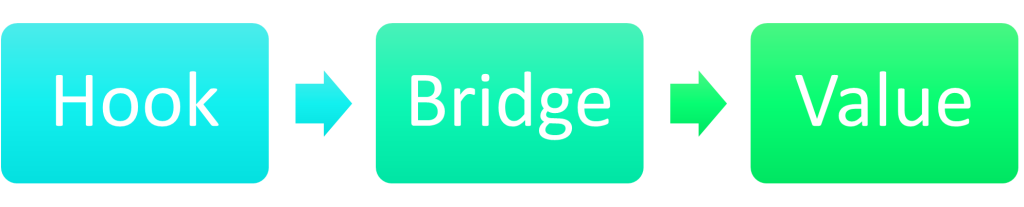
Here are some examples of a bridge line:
- “So let’s get straight to it — here’s what we’re going to break down today…”
- “You’ll see exactly how this applies to you in just a moment.”
- “Let me give you the main idea first, then we’ll unpack it step by step.”
These transition phrases cue your brain to move forward instead of drifting.
Write 3–4 of your own bridge lines and keep them on a sticky note next to your camera.
Start every stream with a 3-point map
Before going live, write only three bullet points on a visible paper or notepad:
- Your main idea
- One example or story
- One takeaway
This stops the mental chaos that causes mumbling. When your brain knows where you’re going, your speech naturally tightens.
You can even say it out loud early:
“Here’s what I’ll share with you today — first, what this really means; second, what’s blocking most people; and third, how to change it.”
That structure locks the audience and you into a clear flow.
Use a verbal warm-up on camera
Of course, the best way to prepare for a live stream is to rehearse. But who has the time these days? If you are streaming daily like me, you definitely will be short of time for this. So, if off-camera rehearsals don’t fit your time, warm up live — strategically.
Start your stream 2–3 minutes before you “officially start.” Use that time to:
- Greet early joiners casually.
- Ask them where they’re watching from.
- Comment on something light.
That warms up your energy before the real content begins. Then, when you officially start, you’re already in rhythm. You can even say:
“Alright, let’s dive in — today’s topic is something I’ve wanted to talk about for weeks…”
That moment marks your real start (you can even timestamp it later if you repurpose the recording).
Train your internal clock with timed openings
For your next 10 live streams:
- Challenge yourself to get to your main point within 90 seconds.
- Set a timer next to you or glance at the clock.
This pressure builds a “speed muscle.” - Within 5–7 streams, you’ll naturally begin getting to the point faster, even without a timer.
Shift mindset: “People are already listening”
Sometimes mumbling comes from subconsciously feeling like you still need to earn attention — even after a strong hook.
Tell yourself:
“They’re already interested — now I just have to deliver.”
That mindset reduces filler talk and helps your tone settle faster into authority and clarity.
End each stream by noting what worked
After every stream, jot down:
- “Where did I start losing focus?”
- “What was the sentence that finally made it interesting?
Over time, you’ll start to see patterns in what triggers the transition into your “flow state.” Then, begin your next stream from that point forward.
In the next section of this article, we will discuss the warm up script and a bridge template designed specifically for your live streams so you can hit your rhythm fast and transition smoothly into your main topic.
1-Minute On-Camera Warm-Up Script
You’ll use this part before you officially start your topic — it warms you up live and builds natural energy without wasting time.
Duration: ~60 seconds
Let’s review this example:
“Hey everyone, good to see you again — welcome back to the stream! I’ve been thinking about today’s topic all week because it’s one of those things that shows up everywhere once you notice it.
Before we dive in, tell me in the chat — have you ever felt [related situation/question]? I’m curious how many of you can relate to that.
Alright, let’s get straight into it — because what I’m about to share can really change how you look at [theme]. Let’s go.”
Here is what makes it work:
- The first line instantly centers your voice and body (instead of jumping straight into content).
- The question invites early engagement and buys you a few seconds to settle.
- The final “let’s go” cue helps you mentally switch into delivery mode.
Bridge Template (to get from hook → main point fast)
You’ll use this immediately after your hook.
The goal is to train your brain to jump from attention-grabbing to value-giving without drifting.

Let’s review this example on coaching topic:
“Most people think motivation disappears because they’re lazy — but that’s not true.
In the next few minutes, I’ll show you the real reason why motivation drops and a simple way to restart it immediately.
Here’s how it breaks down — first, what’s actually happening in your brain, and second, what to do instead. So let’s start with the first part…”
Here is another example on topic of entrepreneurship:
“You know what’s harder than starting a business? Staying confident when it’s not paying off yet.
Today, I’ll share the 3 biggest mindset traps entrepreneurs fall into in that phase — and how to fix each.
Let’s start with the first one…”
Print or memorize 3 bridge phrases you can rotate through:
- “Let’s get straight to it — here’s what we’re going to break down.”
- “Here’s the main idea, then I’ll walk you through how it works.”
- “So let’s unpack this from the start — it’s simpler than it seems.”
Say one out loud every time you finish your hook — it conditions your mind to move forward instead of looping.
More Bridge Templates
Here you can download more bridge templates.
High-Energy Bridge (Motivational or Impact Topics)
“Most people struggle with this part — not because they don’t care, but because no one explains how to actually do it.
So today, I’ll break it down clearly — first, what’s really holding you back, and second, what to do differently starting today.
Let’s jump right in.”
Use this when you want fast momentum and clarity.
Reflective Bridge (Mission, Purpose, or Mindset Topics)
“When I started thinking about this, I realized how deeply it affects the way we live and create.
So in this stream, I want to unpack what’s really behind it — what it means for your mission, and how to realign when you drift away from it.
Let’s start with what most people overlook…”
Use this when you want depth, connection, and slower pacing.
Practical Bridge (Goal Setting, Planning, or Systems Topics)
“Alright, so here’s what we’re going to cover — first, the main mistake people make with this, second, the exact process I recommend, and third, how to apply it in your day-to-day routine.
Let’s begin with that first step.”
Use this when you’re teaching frameworks, strategies, or step-by-step guidance.
Quick Tip for Habit Building
Most probably it is not going to be an easy job to memorize all of the phrases right away. But with time it will become your second nature. To speed up the process you can print them or keep a sticky note near your setup with:
HOOK → BRIDGE → VALUE
“Let’s get straight to it — here’s what we’ll break down…”
Say that every stream. Within 10–15 lives, your brain will start skipping the mumbling phase entirely — because it’ll have a trained verbal shortcut into structure.





0 Comments